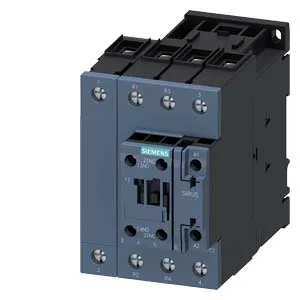
The 75 mm width and 130 mm depth are what you check first against the backpanel layout — that S2 footprint is common across the SIRIUS family, meaning a spare on the shelf swaps into any slot that takes an S2. Side-by-side mounting is allowed, which saves rail space when you're packing multiple contactors in a row. Mechanical endurance is 10 million operations typical, and at AC-1 maximum it can switch 1,000 cycles per hour — that's a contactor built for high-duty cycling, not a cheap relay.
Auxiliary contact ratings — what they actually mean for your circuit
The auxiliary switch is rated across a wide voltage range. At 24 V it handles 10 A; at 48 V and 60 V it's 2 A; at 110 V it's 1 A; at 230 V it's 6 A; at 400 V it's 3 A. The 6 A at 230 V covers most AC control circuits. Don't assume the 24 V rating holds at higher voltages; the curve drops fast after 48 V.
That matters when you're fitting it into a tight corner or a slanted subpanel. The screw terminals accept 2x (0.5 to 1.5 mm²) solid or 2x (0.75 to 2.5 mm²) stranded — standard panel wire, no special ferrules needed. Arcing time is 10 to 20 ms, and the switching time at AC is 10 to 18 ms, so it's fast enough for most motor control sequences. Clearance distances: 50 mm upwards, 50 mm downwards, 10 mm at the side, 0 mm forwards, 0 mm backwards. That 0 mm forwards/backwards means you can butt it against the backpanel or a cover without extra air gap — useful when rail density is tight.