Capacitor switching — what the ratings actually mean
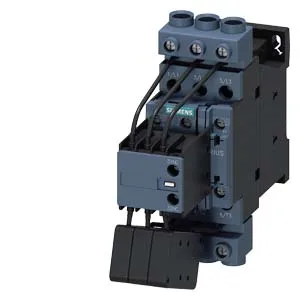
This is a SIRIUS capacitor contactor, not a general-purpose motor contactor. The difference is the inrush handling: switching a capacitor bank means the contactor sees a current surge that can hit 20–30 times the steady-state rating for a few milliseconds. The 3RT2625-1AF05 is built for that — the arcing time is 10 ms, and the switching time at AC is 4 to 16 ms, which means the contacts close fast enough to minimise pre-strike arcing on the capacitor charge cycle. The coil is 110 V AC at 50 Hz — that's the rated control voltage, not the main circuit voltage.
Panel fit and wiring constraints
Size S0 means 45 mm wide, 135 mm tall, 155 mm deep — it takes up one DIN-rail slot at 45 mm pitch. At 40 °C ambient you can land a single 6 mm²; at 60 °C it's 1x 10 mm² or 2x 6 mm². That's enough cross-section for most capacitor bank control circuits.
Switching frequency and thermal limits
Maximum switching rate is 180 operations per hour at voltages up to 600 V, dropping to 150 ops/hour at 690 V. That's about one switch every 20 seconds at the lower voltages — fine for power factor correction banks that cycle on load changes, but not for high-speed switching applications. One auxiliary contact is included (instantaneous contact, 1 NO/NC configurable). No additional attachable auxiliary contact blocks are supported — the zero in the attachable field means what you see is what you get. Plan your feedback wiring accordingly.