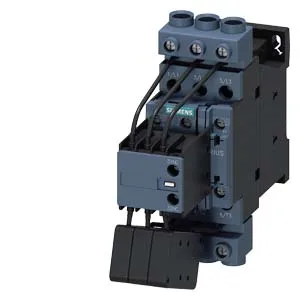
What this capacitor contactor is for
The 3RT2626-1BF45 is a Siemens SIRIUS capacitor contactor — a dedicated switching device for capacitor banks in power factor correction (PFC) panels. Unlike a standard contactor, it is designed to handle the high inrush current when energising a capacitive load without welding its main contacts. The Size S0 footprint — 45 mm wide, 135 mm high, 165 mm deep — fits standard panel layouts and leaves room for adjacent PFC components.
DC coil ratings — the so-what for your control circuit
The coil is DC-operated, rated 110 V nominal with a pick-up threshold of 0.8 × rated value (88 V) and a drop-out at 1.1 × rated (121 V). That means the coil holds in reliably down to about 88 V and releases cleanly at 121 V — important for systems with long cable runs or voltage droop during motor starting. These are the maximum currents the main contacts can break in DC circuits — a common trip point for engineers who assume AC ratings carry over. In DC, arc extinction is harder, so the current limit drops sharply as voltage rises. Arcing time is a tight 10–10 ms, and the contactor can switch at up to 100 operations per hour across the voltage range from 230 V to 690 V. That 100 1/h ceiling is the same for all listed AC voltages — useful when sizing for repetitive capacitor bank switching in PFC cycles.
Termination and wiring
The coil and main terminals are screw-type, accepting solid or stranded wire. Stranded: 2× (1–2.5 mm²) or 2× (2.5–10 mm²). The range covers common panel wiring sizes up to 10 mm² — enough for most capacitor bank connections. Auxiliary contacts: one instantaneous contact is built in (no add-on block needed for basic feedback). The contactor also accepts attachable auxiliary switch blocks (0 attachable as standard — the integrated contact is the only one).
Environmental and mounting flexibility
That means it fits into tight or oddly oriented enclosures without derating. Coil operation time at DC is 15–18 ms — fast enough for most PFC switching sequences but not so fast that it causes mechanical bounce issues on the capacitor load.