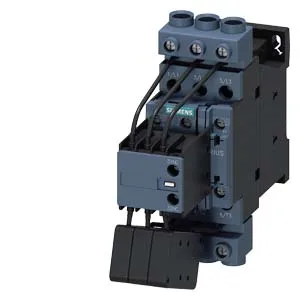
The contact ratings are duty-specific: 6 A at 24 V and 6 A at 230 V, 3 A at 400 V, 1 A at 690 V. At 60 V it's 2 A, at 110 V it's 1 A, at 125 V it's 0.9 A, at 220 V it's 0.3 A. That spread covers control transformers, solenoid valves, and small motor loads across common industrial voltages. Coil operates on AC or DC, 21-28 V, with a pickup power factor of 0.7-1.3 at both 50 Hz and 60 Hz. That means the coil draw isn't constant — it's a ratio of apparent to real power, so factor it into transformer sizing if you're feeding multiple contactors from one supply.
Mounting and wiring — what fits
Width is 45 mm, height 135 mm, depth 165 mm. That's a compact footprint for a contactor in this rating band — three units fit in a 135 mm wide DIN-rail section. Screw terminals accept solid conductors: 2x 0.5-1.5 mm², 2x 0.75-2.5 mm², or 2x 4 mm². Stranded: 2x 1-2.5 mm² or 2x 2.5-10 mm². At 40 °C ambient, a single 10 mm² conductor is the max; at 60 °C you can double up 10 mm². That gives flexibility for panel builders who need to parallel feeds. That helps when retrofitting into existing enclosures where the rail isn't perfectly level.
The storage limit is wider because it governs shelf life, not running duty — don't confuse the two when specifying ambient limits for the panel.
Switching performance and mechanical limits
Arcing time is 10-10 ms — tight, consistent, and independent of load type. That means the arc extinguishes quickly, reducing contact wear and EMI generation during switching. Maximum switching frequency is 100 operations per hour across the voltage range from 230 V to 690 V. That's a thermal limit, not a mechanical one — the contactor can physically cycle faster, but the contacts need time to cool between operations at rated current. That's typical for a contactor this size — fast enough for most sequencing, but not for high-speed interlocking where you'd need a solid-state relay.
What it does — and what it doesn't
No auxiliary contact block is attached (attachable = 0). If your circuit needs a feedback signal or a holding contact, you'll need to add a separate auxiliary switch block. The base unit is a bare power contactor.