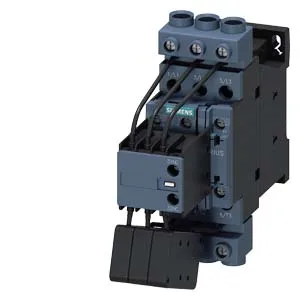
Siemens 3RT2627-1NB35 — SIRIUS Contactor, Screw Terminals, DIN Rail Mount
Its 45 mm width and 135 mm height fit a standard 45 mm modular device footprint, leaving room for adjacent components on the same rail. The 165 mm depth is worth noting for enclosure depth planning — it sits deeper than a typical miniature contactor, so verify gland plate clearance if the panel is shallow. The auxiliary contact block is rated for switching at multiple voltage levels: 6 A at 24 V, 6 A at 230 V, 3 A at 400 V, and 1 A at 690 V. These ratings cover control-circuit isolation for PLC outputs, relay coils, and signal lamps across common industrial voltages. The 0.9 A at 125 V and 0.3 A at 220 V DC ratings confirm it handles DC switching as well, though with derating at higher DC voltages. Arcing time is specified at 10 ms, which helps in coordinating fuse or breaker clearing times for the control circuit.
Solid conductors accepted: 2x (0.5 to 1.5 mm²), 2x (0.75 to 2.5 mm²), and 2x 4 mm². Stranded conductors: 2x (1 to 2.5 mm²) and 2x (2.5 to 10 mm²). The 10 mm² single-conductor capacity at 40 °C and 2x 10 mm² at 60 °C indicate the main power terminals can handle larger cable for higher-current paths, though the contactor's own switching rating is the limiting factor. Screw-type terminals on the coil mean standard Pozidriv or slotted screwdriver termination — no special tooling required. The terminal range covers typical control wiring from 0.5 mm² signal lines up to 10 mm² power feeds.
The storage limit exceeds the operating range — that governs handling and transport, not running conditions.