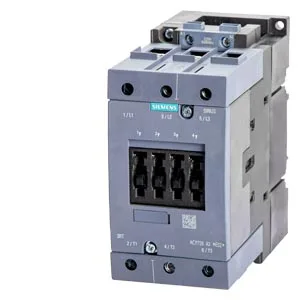
It is rated for 66 kW at 400 V and 60 °C ambient, with a rated insulation voltage of 1000 V and surge voltage resistance of 6 kV — meaning it handles standard 400 VAC line-to-line motor circuits with solid headroom for transient spikes common on factory floors. Mounting is via screw and snap-on onto 35 mm or 75 mm standard DIN rail, with the mounting position allowing ±180° rotation on a vertical surface and ±22.5° forward/backward tilt — useful when the panel layout forces an unconventional orientation. The main circuit uses screw-type terminals accepting 2x (2.5 to 16 mm²) solid or stranded, or 2x (10 to 1/0 AWG). At 40 °C the minimum permissible cross-section is 50 mm²; at 60 °C it drops to 35 mm² — a detail that matters when sizing conductors for a warm enclosure.
Substance prohibitance (RoHS compliance) is declared effective 03/01/2017, so the contactor meets the EU RoHS directive for lead, mercury, cadmium, and other restricted substances.
The motor power ratings at 60 °C ambient — 38 kW at 230 V, 66 kW at 400 V, 114 kW at 690 V — are the derated figures for a warm panel. At 690 V the contactor delivers 25.4 kW, which is the same motor power rating at that voltage. These are the numbers to use when the panel ambient runs hot; the 40 °C ratings would be higher but are not listed here. Electrical endurance varies by duty: AC-1 (resistive) allows up to 900 operations per hour, AC-3 (motor starting) up to 850 per hour, and AC-4 (plugging/inching) up to 250 per hour. The 5000 operations per hour at AC is a switching frequency rating — likely for light-duty resistive switching at reduced current. For short-circuit protection, the required fuse is gL/gG 160 A with type of assignment 2 — meaning the contactor can withstand the let-through energy of a 160 A fuse without welding its contacts, which is the coordination standard for motor starter branches.
Width is 70 mm, depth 139 mm, height 146 mm. Side-by-side mounting is permitted. Auxiliary and control circuits use screw-type terminals as well. The contactor accepts an auxiliary switch block (product extension auxiliary switch is supported), so adding a mirror contact or early-make/early-break signal for a PLC input is straightforward. Coil ratings: at 24 V the rated value is 6 A (likely the inrush or holding current for the DC coil variant), at 110 V it draws 1 A, at 220 V it draws 0.3 A, at 230 V it draws 6 A, and at 400 V it draws 3 A. The 50 Hz rated coil voltage is 48 V. These are the control-circuit draws to budget in the 24 VDC or 230 VAC supply.