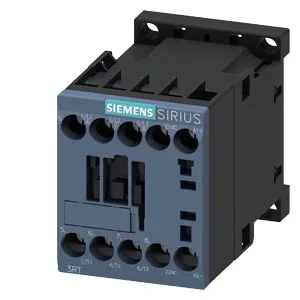
Panel fit and mechanical constraints
The 3RT6015-1BB42: Both main and auxiliary circuits use screw-type terminals — no special tooling needed beyond a standard screwdriver.
AC-3 motor switching capacity and thermal limits
These are the motor-switching currents — the values that determine whether this contactor holds in on a motor start without welding the main poles. Holding current is lower, but the 6 A figure governs the DC supply sizing for the control circuit. The coil also has ratings at 110 V (1 A), 220 V (0.3 A), and 230 V (10 A, likely AC coil variant behavior). Mechanical endurance is 30 million cycles typical — that's the contactor body, not the contacts under load. Electrical life depends on the switching category; at AC-3 maximum the contactor is rated for 750 operations per hour, at AC-4 (plugging/inching) it drops to 250 per hour. The DC switching rate is 10,000 operations per hour, reflecting the lower arc energy on DC loads.
Environmental envelope and compliance
Pollution degree 3 means the contactor tolerates conductive pollution (condensation, light dust) typical of industrial control panels — no conformal coating required for normal factory environments. The substance prohibition date of 05/01/2012 aligns with RoHS compliance timelines — the contactor meets EU substance restrictions for that period. The product extension for auxiliary switches is supported — the contactor accepts add-on auxiliary contact blocks, though the specific block order code is not listed here. This allows field-configurable NO/NC auxiliary contacts without replacing the main contactor.