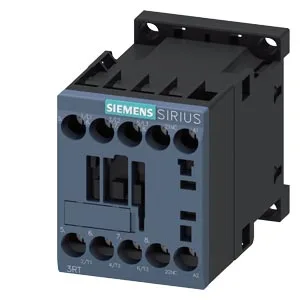
Its coil pulls in at 48 V, 50/60 Hz, making it a straight match for panels with a 48 V control transformer — common in older European installations or systems where 24 VDC isn't the standard. Rated for motor duty, it handles 13 kW at 400 V and 60 °C ambient, and up to 22 kW at 690 V at the same temperature. That 60 °C rating matters out here in the grease — a contactor near a hot motor or inside a crowded panel sees real heat, not the ideal 40 °C lab number. The 400 V figure is the one most European line feeds will hit. The AC-3 and AC-3e switching frequency maxes at 750 operations per hour, which covers most start-stop conveyor and pump cycles. If you're cycling faster than that — say a rapid-reversing application — step up to the AC-4 rating of 250 ops/h.
The contactor measures 45 mm wide, 57.5 mm tall, and 73 mm deep — a compact footprint that fits tightly on a DIN rail alongside other S00 devices. Fastening is screw-and-snap-on onto 35 mm rail per DIN EN 50022, so it clips in place without tools and stays put with the screw for vibration resistance. Mounting position is flexible: it can sit flat on a vertical surface, rotate ±180°, or tilt ±22.5° forward or back. That helps when you're squeezing it into a tight gland-plate layout or an angled sub-panel. Terminals accept 2x 0.5 to 2.5 mm² solid or stranded, or 2x 4 mm² — enough for the motor leads on a 13 kW load. At 60 °C ambient, the minimum permissible conductor is 2.5 mm²; at 40 °C it drops to 4 mm². That's a real-world derating factor when the panel is near the process heat.