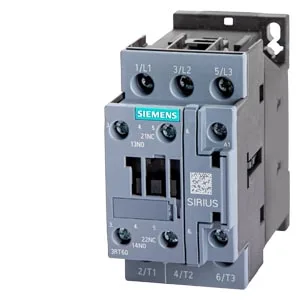
It carries AC-3 ratings at 400 V delivering 23 kW at 60 °C ambient, and 13.3 kW at 230 V or 40 kW at 690 V under the same temperature condition — so it handles common 400 V motors in the 22–25 kW range without derating in a warm enclosure. That operating ceiling matters if the panel sits near a kiln, furnace, or compressor — many contactors derate hard above 40 °C; this one holds its full power rating at 60 °C. Mounting is screw-fixed or snap-on onto 35 mm DIN rail per EN 50022, and the position allows ±180° rotation on a vertical surface plus ±22.5° tilt forward/backward — useful when the panel layout forces an odd angle.
AC-3 duty (starting squirrel-cage motors, breaking during run) is the relevant rating for most conveyor, fan, and pump loads. The contactor is rated for a maximum of 690 V AC-3 and AC-3e, with a maximum switching frequency of 1 000 operations per hour under AC-3. For heavy-duty AC-4 (plugging, inching) the max drops to 300 ops/h — stay within that if the application involves frequent reversing or jogging. The coil draws 6 A at 24 V rated value, 1 A at 110 V, 0.3 A at 220 V, and 10 A at 230 V — these are inrush or holding figures depending on the coil type; the 230 V 10 A figure is notably higher than the 220 V 0.3 A, so confirm your control voltage matches the coil variant exactly.
Side-by-side mounting is permitted (no derating gap required), so you can pack multiple units in a row without losing panel space. Main circuit terminals are screw-type, accepting 2x (0.5 to 1.5 mm²) or 2x (0.75 to 2.5 mm²) solid or stranded wire. The minimum permissible conductor cross-section at 40 °C and 60 °C is 10 mm² for the main circuit — that is a relatively large wire for a size S0 contactor, so plan your lugging and gland plate accordingly.