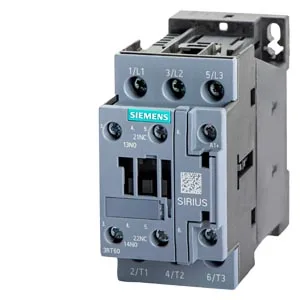
Its 24 VDC coil draws 6 A at the rated value, so the control-circuit supply must be sized for that inrush — a standard 24 VDC power supply handles it, but a marginal one may drop out during pickup. The contactor is rated for AC-3e duty at 23 kW at 400 V and 40 kW at 690 V, meaning it switches standard squirrel-cage motors up to those power levels under full load.
The headline AC-3e rating of 23 kW at 400 V (at 60 °C ambient) is the figure that governs motor switching for most European and Asian 400 V line supplies. At 690 V the same contactor handles 40 kW, and at 230 V it manages 13.3 kW. These are the practical limits for starting and stopping induction motors under load — exceed them and the contacts may weld or wear prematurely. For resistive loads (AC-1) the contactor can switch at up to 1,000 operations per hour, while motor loads (AC-3) max out at 750 ops/h and the more severe plugging/inching duty (AC-4) at 250 ops/h. The DC switching capacity is lower: 1,500 ops/h. These limits are thermal — the contactor needs time to dissipate arc heat between operations.
The 45 mm width (S0 frame) fits a standard 9 mm-module DIN rail grid — it occupies 5 modules. Depth is 107 mm, height 85 mm. Main and control circuits use screw-type terminals accepting 2x (0.5…1.5 mm²) solid/stranded or 2x (0.75…2.5 mm²), with AWG equivalents of 2x (16…12) or 2x (14…8). Minimum conductor size at 40 °C or 60 °C is 10 mm² for the main circuit.