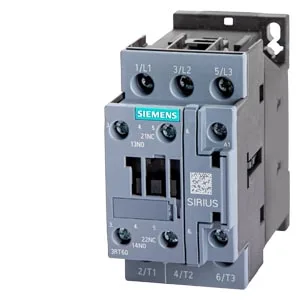
At 400 V it handles 27.5 kW motor loads; at 690 V it goes to 47.5 kW. That's the rating that decides the fit for most three-phase motor circuits — the AC-3 figure governs switching of squirrel-cage motors under starting and running conditions. The coil pulls 6 A at 24 V rated value, drops to 1 A at 110 V and 0.3 A at 220 V. Main and auxiliary circuits both use screw-type terminals — standard for panel wiring, no special tooling needed.
That helps when the panel layout is tight or the gland plate forces an odd angle.
What the switching rates tell you
Maximum mechanical switching rate is 5 000 cycles per hour for general AC use. Duty-specific limits: AC-1 (resistive loads) maxes at 1 000 1/h, AC-3 (motor starting) at 750 1/h, AC-4 (plugging/reversing) at 250 1/h. The AC-3e rating matches the AC-3 figure — 750 1/h. If your application cycles a conveyor motor every few seconds, the AC-3 limit is the one that governs contactor life.
The storage range is wider because the contactor isn't switching under those extremes — just sitting on the shelf. RoHS compliance date is May 1, 2012, so it meets the EU substance restrictions that matter for equipment shipped into regulated markets.