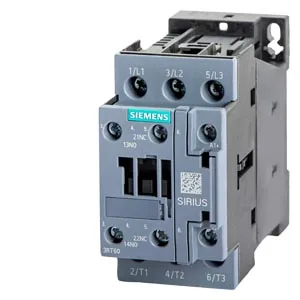
Coil voltage is 110 V — that's the control supply it pulls from, not the main power circuit. At 400 V and 60 °C ambient the contactor handles 27.5 kW of motor load under AC-3 duty, which is the standard category for starting squirrel-cage motors and disconnecting them under full load. That 27.5 kW figure at 60 °C tells you it doesn't need derating in a warm panel; the same rating at 40 °C would be higher, but the 60 °C number is the one that governs a real industrial enclosure with drives and transformers throwing heat. The S0 frame measures 45 mm wide and 85 mm tall, with a depth of 107 mm including terminals. That 45 mm width is standard for the S0 family, so it occupies one slot in a multi-contactor lineup. Side-by-side mounting is permitted, meaning you can pack several contactors on the same DIN rail without a gap — useful when you're building a motor control center and every millimeter of rail space counts. For DC switching applications, the contactor is rated at 6 A at 24 V DC, 1 A at 110 V DC, and 0.3 A at 220 V DC. These are the maximum resistive DC currents the contacts can interrupt — DC arcs are harder to extinguish than AC, so the ratings drop sharply as voltage rises. If you're switching a DC solenoid or a brake coil, match the voltage and current to these figures, not the AC-3 motor rating.
The main terminals accept 2x (0.5 to 1.5 mm²) solid or stranded, or 2x (0.75 to 2.5 mm²) — that's enough for the motor leads on a 27.5 kW load at 400 V, assuming the cable is sized for the full-load amps. Auxiliary terminals are screw-type as well, with the same wire ranges. The contactor also supports an auxiliary switch block (product extension auxiliary switch: yes), so you can add a mirror contact or a status feedback contact without replacing the whole unit. That covers most panel layouts — horizontal busbars, vertical wiring ducts, or a slanted backplate.