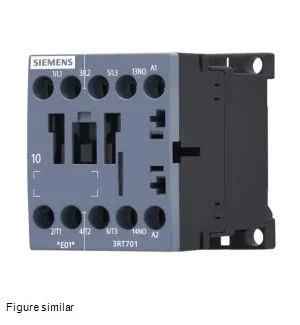
Siemens 3RT7017-1AP02 — S00 Contactor, AC Coil
Rated for AC-1 duty at 6 A on 230 V, 3 A at 400 V, and 1 A at 690 V. That resistive-load curve covers heater banks, lighting, and transformer primary switching. For motor loads (AC-3), the maximum operating rate is 750 operations per hour; for AC-4 (plugging/reversing), it's 250 operations per hour — per the datasheet, those are the thermal limits, not the electrical endurance.
The control supply voltage is AC; closing power of the magnet coil is 0.8 W, holding power drops to 0.27 W DC. That low holding power means the coil runs cool in continuous duty — relevant for densely packed panels where heat rise is a concern. Auxiliary contacts are rated for PLC-level signals: the datasheet specifies contact reliability at 17 V, 5 mA, so you can wire them directly to a 24 VDC digital input without worrying about oxide-film failures at dry-circuit levels. The product extension auxiliary switch option is available if you need additional N/O or N/C contacts beyond the main poles.
Protection and Coordination
For type of coordination 2 (no-weld protection), the required upstream fuse is a gL/gG NH 3NA: 20 A. For type 1 coordination (no-fire protection), it's 35 A. Terminals are screw-type for both main and auxiliary circuits, accepting 2 x (0.5 to 1.5 mm²) solid or stranded, or 2 x (0.75 to 2.5 mm²) finely stranded with ferrule. Strip length per standard practice — no special tooling required.
IP20 on the front and at the terminal — that's touch-safe but not washdown-rated. Storage temperature spans -25 to +70 °C; the operating range is -10 to +55 °C. Shock resistance is 9.8g for 5 ms sine pulse, 5.9g for 10 ms — adequate for most industrial machinery but not for high-vibration mobile equipment without additional damping.