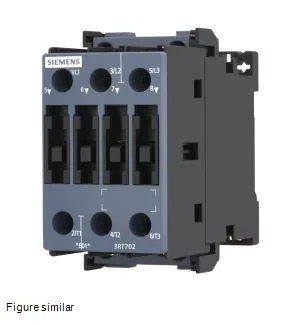
The coil pulls 24 VAC, and the auxiliary contacts are specced for PLC-level reliability at 17 V, 5 mA, so you can drive them straight into a digital input without worrying about contact wetting.
The specific current values at different voltages tell you where it fits — 6 A at 230 V, 3 A at 400 V, and 1 A at 690 V. That's a contactor sized for smaller motors, pumps, or fans, not a big compressor. The DC-13 rating at 220 V is 0.3 A, so if you're switching DC solenoid valves or brake coils, keep that limit in mind. The coil holds at 0.24 W DC, with a closing power of 0.82 W DC. That's a low-hold design — the coil driver doesn't need to dump a lot of heat into the panel. Switching frequency maxes out at 800 operations per hour under AC-3 duty, and 250 per hour under AC-4 (plugging/inching). That's plenty for a typical conveyor or pump start cycle, but if you're doing rapid reversing or jogging, you'll want to check your duty cycle against that AC-4 ceiling. The contactor is rated for 6 kV surge voltage resistance, which is standard for industrial control panels with some transient exposure.
The S0 frame is 45 mm wide, 85.5 mm high, and 91 mm deep — it'll fit standard enclosure backplates. Terminals accept 2x (0.5 to 1.5 mm²) solid or stranded, or 2x (0.75 to 2.5 mm²) with ferrules. That covers most control wiring up to 14 AWG. The auxiliary switch block is field-addable, so you can snap on a front-mount auxiliary contact block later if you need feedback or interlocking. IP20 on the front and terminals means it's finger-safe but not washdown-rated — keep it in the enclosure.