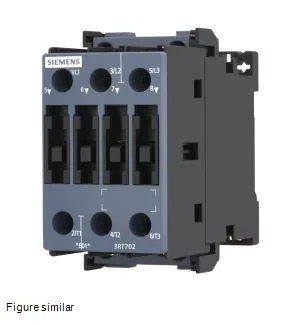
Siemens 3RT7025-1AP05 SIRIUS Contactor — 3-Pole, AC Coil, S0 Size
It accepts an AC control supply voltage and terminates via screw-type terminals on both the main and auxiliary/control circuits. The main contacts are three normally-open poles; auxiliary contact expansion is supported via the product extension option. IP20 on the front and terminal area.
For AC-3 motor-switching duty, the 3RT7025-1AP05 is rated at 6 A at 230 V and 3 A at 400 V, with a maximum operating voltage of 690 V. The AC-3 maximum switching frequency is 800 operations per hour; under the more demanding AC-4 duty (plugging/reversing), that drops to 250 operations per hour — a real constraint if your application cycles the contactor hard. For DC-13 (solenoid/brake) loads at 220 V, the rated operational current is 0.3 A — enough for a small brake coil but not for a large DC motor contactor. Fuse coordination: with type 2 coordination (no damage to the contactor), use a 25 A gL/gG NH 3NA fuse; with type 1 coordination (contactor may need replacement), a 63 A fuse of the same class is permitted.
Physical Integration and Environment
The S0 form factor measures 55 mm wide, 85.5 mm high, and 91 mm deep — a compact footprint that fits standard DIN-rail enclosures. Operating temperature range is -10 to +55 °C; storage range extends from -25 to +70 °C. The shock resistance is specified at 12.5g for 5 ms and 7.8g for 10 ms — adequate for most industrial panel applications but not for extreme vibration environments. Wire termination accepts 2x (0.5 to 1.5 mm²) solid or stranded, or 2x (0.75 to 2.5 mm²) with ferruled ends — standard panel-building sizes. The coil draws 0.24 W holding power at DC, with a closing power of 0.82 W.
For BOM freeze or second-source planning, the closest functional peer in the same SIRIUS family is the 3RT6026-1AN20 — same S0 frame, similar AC-3 ratings, and same DIN-rail footprint. The key difference is the coil voltage; verify your control supply matches before substituting.