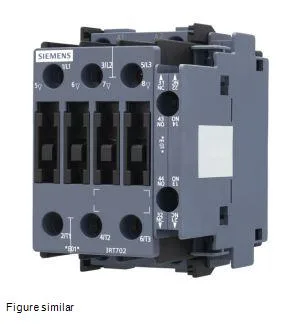
The Siemens 3RT7026-1AQ05 is a Size S0 3-pole contactor with three normally-open main contacts.
Current ratings and what they drive
Rated 6 A at 230 V, 3 A at 400 V, and 1 A at 690 V in AC-3 duty — those are the motor-switching currents for a standard 3-phase induction motor load. The AC-3 curve is the one that governs real-world contactor sizing for squirrel-cage motors: at 400 V line, this contactor handles a motor drawing roughly 3 A full-load, which corresponds to about a 1.5 kW motor at 400 V three-phase. The 690 V rating is there for 690 V line systems (common in mining or heavy industrial), but the current drops to 1 A.
Switching frequency and control reliability
Maximum switching rate is 800 operations per hour under AC-3 load, and 250 ops/h under AC-4 (plugging/reversing duty). That's enough for a conveyor start-stop cycle but not for a high-speed pick-and-place.
The magnet coil draws 0.82 W during closing and holds at 0.24 W DC. That low holding power keeps the coil cool in a sealed panel and reduces the burden on a 24 VDC power supply. Surge voltage withstand is 6 kV, pollution degree 3, so it's rated for the dirty, humid environments typical of industrial enclosures without conformal coating.
Mounting and integration details
Wire size: 2 x 0.5 to 1.5 mm² solid/stranded or 2 x 0.75 to 2.5 mm² with ferrules. Screw terminals on both main and control circuits — no spring-cage option on this order code.
Fuse coordination and short-circuit protection
For type 2 coordination (contactor remains operational after a fault), step down to a 35 A gL/gG fuse. That's a standard distinction: type 2 is preferred for production-critical lines where you want to clear a fault and restart without swapping the contactor.