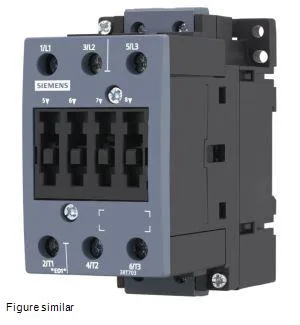
Side-by-side mounting is allowed, which helps when packing multiple contactors in a row on the rail. At 55 mm wide, it's the S2 footprint, so it'll drop into the same DIN space as other S2 devices without re-drilling the gland plate. Main and auxiliary/control circuits both use screw-type terminals. Wire range accepts 2x (0.5 to 1.5 mm²) solid or stranded, or 2x (0.75 to 2.5 mm²) with ferrules. For a panel builder, that means you can land two conductors per clamp — handy for daisy-chaining control voltage.
The mechanical switching frequency is 800 operations per hour under AC-3, 250 under AC-4 (plugging/reversing). That's enough for most conveyor or pump cycles; if you're doing high-speed jogging, you'll want to check the thermal curve. For short-circuit coordination, the evidence lists two fuse requirements: Type 2 coordination needs an 80 A gL/gG NH 3NA fuse; Type 1 needs a 125 A. That's the selectivity target for the upstream protection device — don't undersize it if you're aiming for Type 2 (no damage to the contactor after a fault). Auxiliary contacts are rated for PLC-level signals — the evidence calls out acceptability for PLC control at 17 V, 5 mA. That means the contacts are gold-flashed or otherwise treated to switch dry logic levels without oxidation issues. If you're feeding a 24 VDC PLC input, this contactor won't give you intermittent signals from contact film. Coil power: 0.78 W closing, 0.42 W holding at DC. That's a low hold-in power, which keeps the heat rise down inside a crowded panel. The magnet coil is DC-operated, so verify your control voltage polarity and suppression if you're paralleling with inductive loads.
Operating temperature range is -10 to +55 °C; storage from -25 to +70 °C. Shock resistance is 15g for 5 ms and 8g for 10 ms on the sine pulse — enough for most machine-mounted applications unless you're near a stamping press.