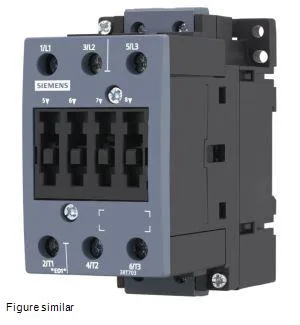
The control supply is AC voltage, with a coil that draws 0.76 W closing power and holds at 0.35 W DC.
Ratings that matter for the panel
The AC-3 maximum switching frequency is 800 operations per hour; if you're pushing into AC-4 duty (plugging, inching), that drops to 250 per hour. That's the difference between running a conveyor and jogging a press — plan your cycle times accordingly. Fuse coordination is spelled out: for Type 2 coordination you need gL/gG NH 3NA fuses rated at 100 A; for Type 1 coordination, those same fuses go to 160 A. That's your short-circuit protection curve — match it to your upstream breaker or the coordination study won't hold. Operating temperature range is -10 to +55 °C, storage from -25 to +70 °C. The enclosure rating is IP20 on the front and IP00 at the terminals — the terminals are live when the panel door is open, so standard finger-safe shrouding or a cover is expected.
Both the main current circuit and the auxiliary/control circuit use screw-type terminals. The main terminals accept 2x (0.5 to 1.5 mm²) solid or stranded, or 2x (0.75 to 2.5 mm²). Finely stranded wire with core-end processing follows the same cross-section range. That covers most panel wiring up to 2.5 mm² — if you're running larger motor feeders, you'll need a terminal adapter or a larger frame size. The contactor accepts auxiliary switch modules as a product extension, so you can add NO/NC blocks for feedback or interlocking without replacing the base unit.