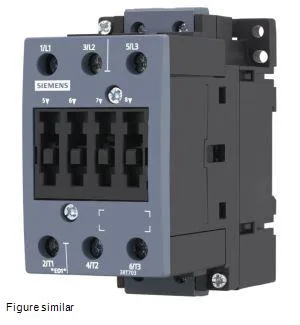
Pollution degree 3 rating means it handles conductive dust and condensation typical of industrial control cabinets without derating creepage distances.
The AC-3 rated operational current maximum is 690 V — that's the voltage ceiling for switching squirrel-cage motors. For DC-13 loads at 220 V, the contactor switches 0.3 A — useful for solenoid valves or DC brake coils in mixed-voltage panels. The closing power of the magnet coil draws 0.79 W DC; holding power drops to 0.36 W DC, meaning the coil runs cool once sealed and the control transformer can be sized lean. Switching frequency maxes at 800 operations per hour under AC-3 and 250 per hour under AC-4 — the AC-4 figure governs plugging and inching duty, so if your application reverses or jogs the motor frequently, stay under that ceiling.
The contactor accepts 2 x 0.5 to 1.5 mm² solid or stranded, or 2 x 0.75 to 2.5 mm² — fine for control wiring up to the main circuit rating. Shock resistance is 15 g for 5 ms and 8 g for 10 ms sine pulse, which covers most industrial vibration environments short of a press or crusher.