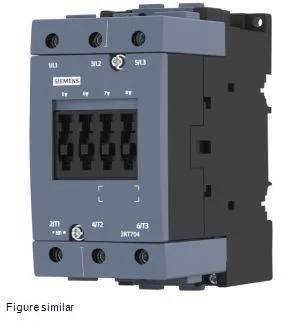
The three normally-open main contacts handle the power circuit; there are no NC main contacts on this variant. Mounting is flexible: screw-fix or snap onto a 35 mm or 75 mm standard mounting rail. Front protection is IP20 — safe against finger contact when installed in an enclosure. The terminal area is rated IP00, meaning the connection points are not touch-protected on their own; the panel enclosure provides the required safeguarding.
The AC-3 maximum switching frequency is 800 operations per hour; for AC-4 (plugging/inching) duty it drops to 250 operations per hour. That tells you this contactor is designed for normal motor starting cycles, not for high-speed jogging applications. If your application needs frequent reversing or inching, the AC-4 limit governs the real duty cycle. Auxiliary contacts are rated for PLC-level reliability — the spec calls out acceptability for PLC control at 17 V, 5 mA. That means the silver-alloy contacts are designed to switch low-energy signals without oxidation problems, so you can wire the auxiliary block directly to a 24 VDC digital input card without worrying about contact wetting current. The coil is AC-operated with a closing power of 0.61 W DC equivalent and a holding power of 0.26 W DC equivalent. These are low enough to keep control transformer sizing modest in a multi-contactor panel. For type 1 coordination (no-weld-after-fault), the spec calls for a gL/gG NH 3NA fuse rated at 200 A upstream. That is the maximum fuse that still protects the contactor under short-circuit conditions — verify your existing branch-circuit protection does not exceed this if you are retrofitting into an existing panel.
Environmental and Installation Limits
The storage range matters if you are holding this as a critical spare in an unheated warehouse — it can sit through a winter without damage. Installation altitude is limited to 2000 m above sea level; above that, dielectric strength and air-gap clearance derate, so a different contactor or derating factor applies.