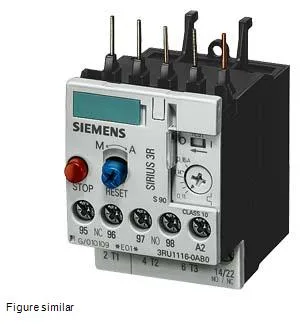
It mounts directly to a contactor via the fastening method (contactor mounting), making it a matched pair for a motor starter assembly in a control panel. This protects the motor winding from sustained overload without nuisance tripping on normal starting inrush. The relay carries ATEX certification (DMT 98 ATEX G 001), so it is suitable for use in potentially explosive atmospheres where motor protection must meet directive 2014/34/EU. The IP20 front protection keeps fingers and tools away from live terminals inside the enclosure.
Size S00 footprint: 45 mm wide, 87 mm tall, 78 mm deep. It clips onto the contactor without needing extra DIN-rail space — the zero clearance upwards, forwards, backwards, and downwards (all 0 mm) means no extra gap required around the relay itself. Side clearance of 6 mm is needed for airflow and wiring access. Accepts solid conductors: 2× (0.5…1.5 mm²) and 2× (0.75…2.5 mm²), plus AWG equivalents 2× (20…16), 2× (18…14), 2× 12. Finely stranded with core-end processing uses the same ranges.
Power dissipation per pole is 1.6 W — three poles total 4.8 W. This matters for thermal management inside a sealed enclosure; at full load the relay contributes measurable heat that must be considered in the cabinet cooling budget. Auxiliary contact ratings vary by voltage: 1 A at 24 V, 3 A at 120 V, 2 A at 230 V, 1 A at 400 V. These are the switching capacities for the N/O and N/C contacts that signal overload status to a PLC or annunciator. The 400 V rating confirms it can switch control voltage in a 400 VAC control circuit directly. Surge voltage resistance rated at 6 kV — this is the impulse withstand level for the auxiliary contacts, matching typical IEC 60947-5-1 requirements for industrial control circuits. It means the relay can handle switching transients without contact welding or insulation breakdown. Shock resistance: 8g for 10 ms. This is the mechanical robustness against vibration and shock in industrial environments — think hammer drills, stamping presses, or conveyor impact. The relay holds its calibration under those conditions. Operating temperature range -20 to +70 °C, storage and transport -55 to +80 °C. The wide storage range matters for spares stored in unheated warehouses. Relative humidity during operation up to 100% — no derating needed for condensing environments.
Substance prohibitance date of 07/01/2006 aligns with RoHS compliance — the relay is free of restricted substances per EU directive 2011/65/EU.