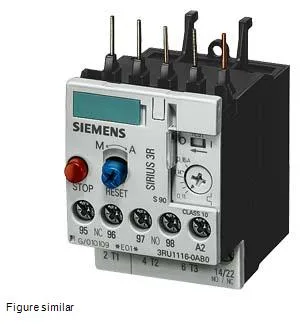
CLASS 10 means the relay will trip within 10 seconds at 7.2× the set current — the standard for standard-duty motor starting where the acceleration time is under 10 seconds. That covers most pump, fan, and conveyor applications; for longer ramp times you'd step up to CLASS 20 or CLASS 30.
The auxiliary contact block carries a range of ratings: 1 A at 24 V, 3 A at 120 V, 2 A at 230 V, and 1 A at 400 V. These are the make/break capacities for the N/O and N/C signaling contacts — they feed the PLC input or the contactor coil circuit. The 400 V rating at 1 A confirms it can switch a 400 V control circuit directly, which is common in European panels. Power dissipation is 1.6 W per pole, so about 4.8 W total through the main current path. That's low enough that no special ventilation is needed inside a standard IP20 enclosure, but it's worth accounting for in a densely packed panel with multiple relays side-by-side. Screw-type terminals on both the main and auxiliary circuits accept solid and finely stranded conductors: 2x (0.5...1.5 mm²) and 2x (0.75...2.5 mm²) per clamp, or the AWG equivalents. That covers the common motor lead and control wire sizes for a Size S00 starter.
It mounts directly onto the contactor (contactor mounting), with no additional DIN-rail space needed. Clearance requirements are minimal: 0 mm upwards, forwards, backwards, and downwards, with 6 mm at the side. That means it can be stacked or placed against adjacent devices without derating for airflow — useful when retrofitting into a crowded enclosure. Front-side protection is IP20, so finger-safe against accidental contact. The relay is also ATEX approved (DMT 98 ATEX G 001), meaning it can be used in motor protection circuits for potentially explosive atmospheres when paired with the correct upstream protection.
It withstands 100 % relative humidity during operation — no condensation limits stated, so it's suitable for unconditioned indoor environments. Shock resistance is 8g for 10 ms, typical for industrial panel-mounted gear. RoHS compliance is dated to July 1, 2006, so the part meets the EU RoHS directive.