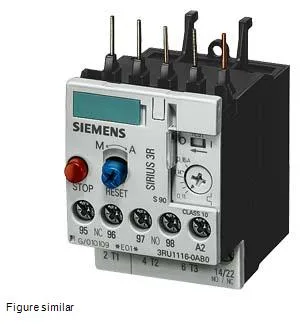
The Siemens 3RU1116-0JB0-ZW98 is a SIRIUS thermal overload relay in Size S00, Trip Class 10, designed for direct mounting onto a matching contactor. It protects three-phase motor circuits against overload and phase failure by monitoring the current draw and tripping the contactor coil when the thermal model exceeds the trip threshold.
This relay fastens directly onto the contactor via the contactor mounting method, with no additional DIN-rail footprint required. The mounting position allows rotation of ±135° on a vertical surface and tilting of ±45° forward and backward, which gives panel builders flexibility in tight enclosures.
Auxiliary Contact Ratings and Trip Class
The auxiliary contact circuit carries a rated current of 1 A at 24 V, 3 A at 120 V, 2 A at 230 V, and 1 A at 400 V — these are the making and breaking capacities for the control circuit that signals the contactor coil. The per-pole power dissipation is 1.6 W, a figure to include in enclosure thermal calculations when the relay is enclosed.
The relay is rated for operation from -20 to +70 °C and storage/transport from -55 to +80 °C, with 100 % relative humidity permissible during operation. Shock resistance is 8 g for 10 ms. The IP20 protection on the front means it is finger-safe against accidental contact but not protected against moisture ingress — it belongs inside a panel, not exposed to washdown. The product carries an ATEX type protection designation (DMT 98 ATEX G 001) for use in potentially explosive atmospheres when installed per the applicable system certificate. The lifecycle status is current production.