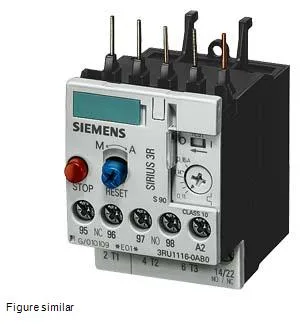
It mounts directly onto a contactor via the fastening method, saving DIN-rail space and simplifying the wiring between the relay and the contactor's main circuit. Its IP20 front protection means the front face is finger-safe against accidental contact, which is typical for enclosed panel installations where the relay is not in a washdown zone.
The relay occupies 45 mm width, 87 mm height, and 78 mm depth. It mounts on a vertical surface with ±135° rotation and ±45° tilt forward/backward, giving flexibility for panel layouts where the contactor is not perfectly upright. This tight clearance allows dense packing on the DIN rail or contactor assembly. Main and auxiliary circuits use screw-type terminals. The main circuit accepts 2× (0.5…1.5 mm²) or 2× (0.75…2.5 mm²) solid or finely stranded wire with ferrule; auxiliary contacts accept 2× (20…16) or 2× (18…14) AWG. Strip length and torque values follow the terminal marking on the relay body.
The auxiliary contact ratings cover common control voltages: 1 A at 24 V, 3 A at 120 V, 2 A at 230 V, and 1 A at 400 V. These are the maximum continuous currents the auxiliary contacts can switch at those voltages — useful for confirming the relay can drive the PLC input or contactor coil in the circuit. Power dissipation per pole is 1.9 W, so total heat for the three-pole relay is 5.7 W. This matters for panel thermal calculations when multiple relays are ganged together. The relay is rated for 100 % relative humidity during operation, so it handles condensation-prone environments inside non-sealed enclosures. Shock resistance is 8 g for 10 ms, sufficient for mounting on contactors that see vibration from switching or nearby motor starters.