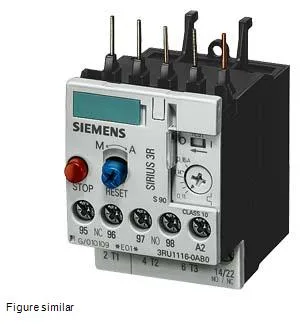
This relay mounts directly to a SIRIUS contactor or as a stand-alone unit on a DIN rail. The ATEX certification (DMT 98 ATEX G 001) confirms it is approved for use in potentially explosive gas atmospheres — a key check for chemical, oil & gas, or grain-handling installations.
That said, if your procurement team is reviewing second-source options or wants a cross-reference for a multi-line contract, the closest functional peer is the 3RT2526-1AF00. The 3RT2526 series shares the same S00 frame, CLASS 10 trip, and screw-terminal wiring scheme. The deciding difference is the auxiliary contact configuration — verify your control circuit needs before swapping order codes.
The 3RU1116-1AB1 is a 3-pole relay. The screw-type terminals for the main circuit accept solid conductors from 0.5 to 2.5 mm² (or AWG 20–12), and the auxiliary/control circuit terminals accept 0.5 to 1.5 mm² (AWG 20–16). That covers the common motor-lead sizes for fractional to small integral-horsepower motors in a panel. Shock resistance is rated at 8g for 10 ms — sufficient for most industrial panel environments, but worth checking if the relay is mounted on a vibrating machine frame rather than a fixed enclosure wall. The operating temperature range of -20 to +70 °C covers standard indoor and many outdoor cabinet installations; storage and transport range extends to -55 to +80 °C. That gives panel builders room to route cables without forcing a specific orientation. The 6 mm side clearance to adjacent devices is a practical detail for dense DIN-rail layouts.
Zero clearance required upwards, forwards, backwards, or downwards, so it can be stacked tight against other devices in the row. Power dissipation is 1.9 W per pole, totaling about 5.7 W at full load.