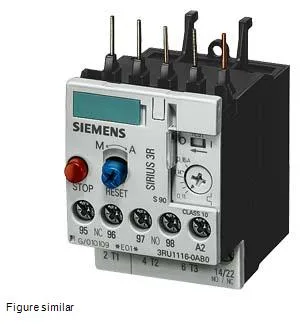
Siemens 3RU1116-1BB1 SIRIUS thermal overload relay
The CLASS 10 trip class is the critical selection parameter: it matches the thermal curve to standard NEMA design B and IEC motors, allowing the starting inrush to pass while protecting against sustained overloads. The relay's size S00 frame occupies a 45 mm width and 87 mm height with a 78 mm depth — this is the smallest SIRIUS frame, suited for compact panels where space is tight. The screw-type terminals for the main current circuit accept solid conductors from 1× (20…16) AWG and finely stranded with ferrule from 2× (0.5…1.5 mm²) up to 2× (0.75…2.5 mm²). Auxiliary contact ratings are voltage-dependent: 3 A at 120 V, 2 A at 230 V, and 1 A at 400 V — so the control circuit voltage determines the switching capacity, not the other way around.
Deployment context and environmental limits
This relay is intended for stand-alone installation inside an IP20-rated enclosure — the front face is finger-safe, but the terminals require the panel door to be closed during operation. It can be mounted on a vertical surface with ±135° rotation and ±45° tilt forward/back, giving flexibility in tight cabinets. It withstands 8g shocks for 10 ms and operates at altitudes up to 2,000 m without derating. The ATEX certification DMT 98 ATEX G 001 qualifies it for use in potentially explosive gas atmospheres — a key differentiator for chemical, oil and gas, or grain handling applications.
Power dissipation and thermal management
In hot operating state at AC, the relay dissipates 5.7 W total, or 1.9 W per pole. This is modest for a size S00 device, but in a densely packed panel with multiple relays side-by-side, the cumulative heat must be considered. The side clearance requirement is 6 mm — adequate airflow for natural convection.