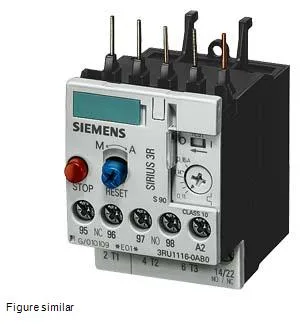
Trip class CLASS 10 is the deciding factor for motor protection: it coordinates with most IEC standard motors up to 10 seconds of locked-rotor time. If your motor has a longer acceleration curve (high-inertia loads like centrifuges), you would need CLASS 20 or 30 — but for general-purpose three-phase motors this is the correct match. The main circuit uses Cage Clamp terminals accepting 2x (0.5... 2.5 mm²) solid or 2x (0.5... 1.5 mm²) finely stranded with ferrule. That covers the typical control wiring range for motor circuits up to around 7 A (depending on the contactor partner). The auxiliary contact block is not included (0 auxiliary contacts as standard), so plan for a separate 3RU1900-.. series block if you need N/O or N/C signaling. Power dissipation is 5.7 W total at AC hot operating state (1.9 W per pole). In a densely packed panel, that heat adds up — the S00 frame is small, so ensure ventilation or spacing per the derating guidelines if ambient exceeds 40 °C.
This relay is deployed in motor control centers (MCCs), distribution boards, and standalone starter assemblies across manufacturing, water treatment, HVAC, and material handling. The ATEX certification (DMT 98 ATEX G 001) permits installation in potentially explosive gas atmospheres (Zone 1 or 2) when paired with an appropriate contactor and enclosure — a common requirement in chemical, oil and gas, and grain handling facilities. The stand-alone installation style means it can be snapped onto a DIN rail or screw-mounted directly, not only paired with a contactor.