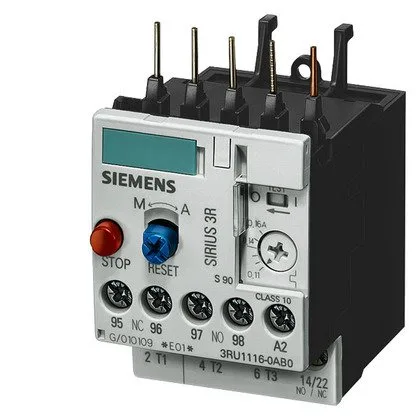
It mounts directly to a contactor — the fastening method is contactor mounting — so it shares the same DIN-rail or screw-panel footprint as the contactor it pairs with, saving a row of rail space. The relay is rated CLASS 10 trip class, meaning it will trip within 10 seconds at 7.2× the set current, which is the standard for standard-duty motor starting (not high-inertia loads that need CLASS 20 or 30).
The relay body is 45 mm wide, 87 mm tall, and 78 mm deep. Zero clearance required upwards, forwards, backwards, and downwards — only 6 mm needed at the side. The 1.9 W dissipation per pole adds up to 5.7 W total at full load — negligible for a ventilated cabinet, but worth noting in a sealed, high-density panel.
Screw-type terminals on both the main and auxiliary circuits accept solid or finely stranded wire with ferrule: 2× (0.5 to 1.5 mm²) or 2× (0.75 to 2.5 mm²) per clamp. For AWG, that translates to 2× (20 to 16) or 2× (18 to 14) solid, plus 2× 12 AWG on the main contacts. The auxiliary contacts handle 1 A at 24 V, 3 A at 120 V, 2 A at 230 V, and 1 A at 400 V — enough for a PLC input or a contactor coil feedback, but not for power switching. The control circuit draws 0.22 A at 110/125 V and 0.11 A at 220 V, so factor that into your 24 VDC power supply budget if you're using a DC coil contactor.