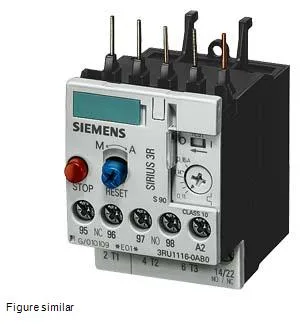
The IP20 front protection keeps fingers out of the terminal area inside the panel; it's not rated for washdown environments, so keep it behind a gland plate or enclosure door.
Mounting and wiring — the practical bits
This relay mounts directly onto a contactor via the contactor mounting interface — no DIN rail bracket needed if you're pairing it with a SIRIUS contactor of matching S00 frame. Screw terminals on both main and auxiliary circuits: main terminals accept 2× (0.5…1.5 mm²) solid or 2× (0.75…2.5 mm²) solid, plus the AWG equivalents (2× 20…16 and 2× 18…14). Auxiliary terminals take 2× (20…16) and 2× (18…14) AWG. That zero-gap top and bottom means you can stack contactor-overload pairs without wasting rail space.
What the ratings mean in the field
Shock resistance rated at 8g for 10 ms — that's enough to survive a forklift bump into the panel or a moderate seismic event without nuisance tripping. Surge voltage withstand of 6 kV gives the relay decent immunity against switching transients on the motor circuit; it's not a full surge protector, but it won't fail on the first spike from a contactor dropout. Power dissipation per pole is 1.9 W — three poles means about 5.7 W total heat inside the enclosure. Factor that into your panel thermal budget if you're running multiple relays in a sealed box.
It carries ATEX approval (DMT 98 ATEX G 001) for use in potentially explosive atmospheres, plus the usual CE marking under the Low Voltage Directive. RoHS compliance date is noted as July 1, 2006, so it's fully RoHS-compliant.