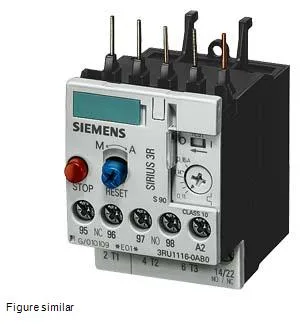
The Siemens 3RU1116-1FB0-ZW96 is a SIRIUS thermal overload relay in Size S00, designed for 3-pole main current circuits with screw-type terminals. It mounts directly onto a contactor, so it takes up no extra DIN rail space — a clean, stacked assembly for motor starter builds.
The auxiliary contact ratings cover a wide control-voltage range: 1 A at 24 V, 3 A at 120 V, 2 A at 230 V, and 1 A at 400 V. That means the same relay works across 24 VDC control schemes and 120/230 VAC panels without swapping out the aux block. Power dissipation is 2.2 W per pole, so a fully loaded three-pole relay dumps about 6.6 W into the enclosure. In a dense panel with multiple starters, that heat adds up — account for it in your thermal budget. The rest of the body is protected by the contactor enclosure it mounts to.
Fastening method is contactor mounting — clips directly onto a SIRIUS contactor in Size S00. No DIN rail needed for the relay. Clearance requirements: 0 mm upwards, forwards, backwards, and downwards from the relay body. Side clearance is 6 mm. That means you can stack contactor-relay assemblies side by side with only 6 mm between them — tight panel layouts are fine. Handles odd-angle cabinet layouts without derating.
ATEX approval (DMT 98 ATEX G 001) is present, so this relay is certified for use in potentially explosive atmospheres — Zone 1 or Zone 2 gas groups, typically. That is a differentiator versus standard thermal relays that lack ATEX marking. Surge voltage resistance rated at 6 kV. Operating temperature -20 to +70 °C, storage/transport -55 to +80 °C. Substance prohibitance date of 07/01/2006 aligns with RoHS compliance scope.