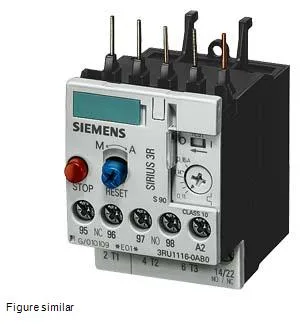
The 3-pole design covers the three phases of a motor circuit. Power dissipation is 2.2 W per pole, so at full load the relay dissipates about 6.6 W total — factor that into your panel's thermal budget if you're packing multiple starters in a small enclosure. Mounting position is flexible: the relay can be mounted on a vertical surface with ±135° rotation or ±45° tilt forward/back. That's useful when you're fitting it into a tight corner of a panel and can't keep everything perfectly square. Clearance requirements are tight — 0 mm upwards, forwards, backwards, and downwards — but 6 mm at the side is needed for air circulation and to avoid heat buildup between adjacent relays.
Both main and auxiliary/control circuits use screw-type terminals. The main circuit accepts solid conductors: 2x (0.5... 1.5 mm²) and 2x (0.75... 2.5 mm²), plus AWG equivalents 2x (20... 16) and 2x (18... 14) and 2x 12. For finely stranded wire with ferrule ends, the same ranges apply. Auxiliary contacts accept 2x (20... 16) and 2x (18... 14) AWG. That's a standard range for control wiring — no special crimp tools needed beyond what's already in your panel shop.
The relay carries ATEX approval DMT 98 ATEX G 001, which certifies it for use in potentially explosive gas atmospheres — specifically for thermal protection of motors in Zone 1 or Zone 2 areas. The substance prohibition date of 07/01/2006 aligns with RoHS compliance (restriction of hazardous substances).