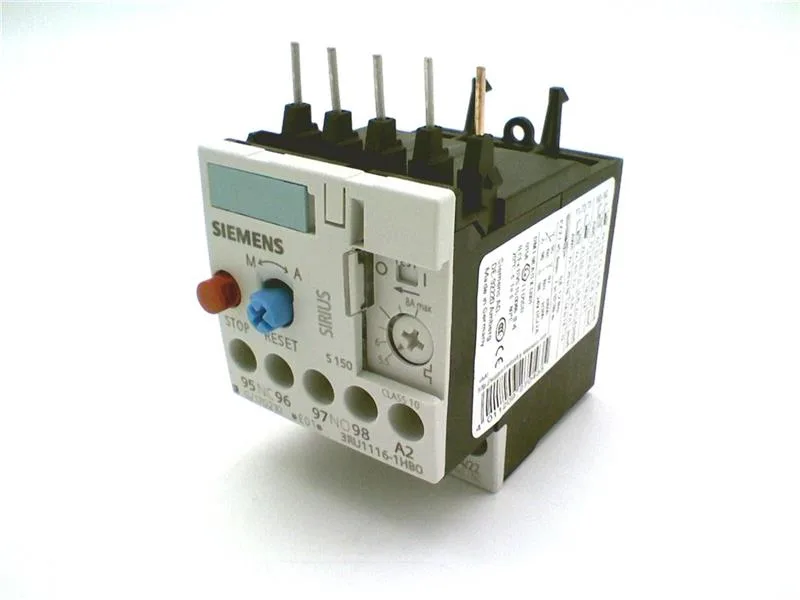
What this relay does on the line
The relay mounts directly to the matching SIRIUS contactor (contactor mounting, per the fastening method), which keeps the power wiring short and the bimetal heater in the same thermal environment as the contactor. For a panel builder, the 45 mm width and 78 mm depth let it sit in a standard 45 mm grid without crowding the adjacent device.
Both the main current circuit and the auxiliary/control circuit use screw-type terminals. The solid and finely stranded with core end processing accept 2× (0.5 … 1.5 mm²) and 2× (0.75 … 2.5 mm²); the AWG equivalents for auxiliary contacts are 2× (20 … 16) and 2× (18 … 14). That covers the common control wiring sizes for a motor starter — 1.5 mm² for the coil circuit and 2.5 mm² for the power loop. The finger-safe touch protection (IP20 on the front) means the terminals are safe to work near with the panel door open, provided the wiring is properly seated.
The relay operates from -20 to +70 °C and can be stored or transported from -55 to +80 °C. Relative humidity during operation can reach 100 %, so it is suitable for unconditioned indoor enclosures where condensation may occur. The substance prohibitance date of 07/01/2006 indicates RoHS compliance from that date. The ATEX type of protection DMT 98 ATEX G 001 means the relay itself is not an ignition source in a gas atmosphere — relevant if the enclosure sits in a Zone 2 area, though the motor circuit protection must still be assessed as a system.