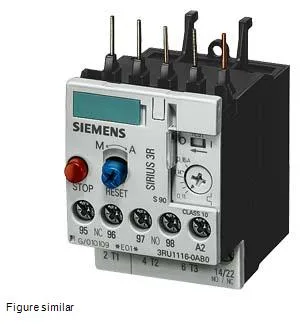
The Siemens SIRIUS 3RU1116-1KB0-ZW97 is a Size S00 thermal overload relay for 3-pole main circuits, designed to protect motors against overload and phase failure by tripping within CLASS 10 time — meaning it will open the contactor within 10 seconds at 7.2× the set current, which is the standard for standard-start induction motors driving pumps, fans, and compressors. It mounts directly onto a contactor (fastening method: contactor mounting) and uses screw-type terminals for both main and auxiliary/control circuits, accepting solid conductors from 2x (0.5... 1.5 mm²) and 2x (0.75... 2.5 mm²) per pole.
The auxiliary contact ratings tell you what control voltage it can switch: 1 A at 24 V, 3 A at 120 V, 2 A at 230 V, and 1 A at 400 V — these are the maximum continuous currents the N/O and N/C signal contacts can carry back to the PLC or safety relay.
It carries ATEX approval DMT 98 ATEX G 001, meaning it's certified for use in potentially explosive gas atmospheres (Group II, Category 2G) — a critical compliance detail for chemical, oil & gas, or grain-handling applications.
Dimensions are 45 mm wide, 87 mm tall, and 78 mm deep — this is a compact S00 frame that fits standard DIN-rail contactor assemblies; the 45 mm width matches a single 45 mm contactor footprint, so it doesn't consume extra rail space. Mounting position is flexible: the relay can be mounted on a vertical surface with ±135° rotation or ±45° tilt front-to-back, which helps when routing wires in tight enclosures. Clearance requirements are zero mm upwards, forwards, backwards, and downwards, but 6 mm is needed at the side for heat dissipation — each pole dissipates 2.2 W, so side clearance is non-negotiable to avoid nuisance tripping.