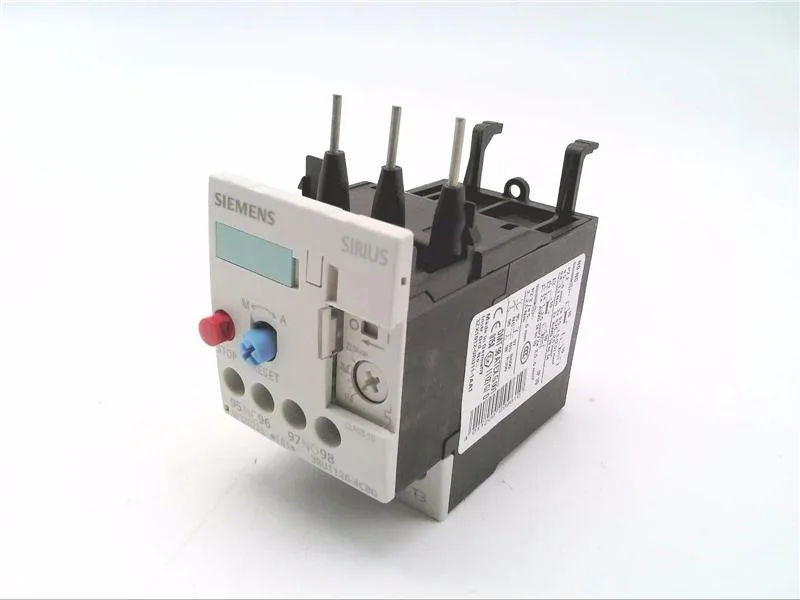
Rated for a 3-pole main circuit with screw-type terminals on both the main and auxiliary/control circuits. Mounts directly to the S0 contactor. S0 frame size pairs with the S0 contactor family.
Trip Class 10 is the headline: at 7.2× the full-load current setting, the bimetal strip forces the contacts open within 10 seconds. That is fast enough to protect a motor winding from a locked-rotor event, but not so fast that it nuisance-trips on a normal high-inrush start. For motors with longer acceleration times (high-inertia loads like centrifuges or large fans), you would step to Class 20 or 30 — but for most standard squirrel-cage motors, Class 10 is the right call. The auxiliary contact ratings are given at multiple voltages: 1 A at 24 V, 3 A at 120 V, 2 A at 230 V, 1 A at 400 V. These are the switching capacities of the built-in N/C and N/O contacts that signal the trip condition back to the PLC or the contactor coil circuit. Power dissipation per pole is 2.2 W, so the total heat load from the three poles is 6.6 W when the relay is carrying rated current. That is moderate — plan for natural convection in the enclosure, but no forced cooling needed in a standard steel cabinet. Surge voltage resistance is rated at 6 kV, which aligns with IEC 60947-1 overvoltage category III for 400 V distribution panels. That means the relay's insulation can handle switching transients from contactor coils and nearby lightning-induced surges without flashover.
Fastening method is contactor mounting — clips directly onto the SIRIUS S0 contactor. No DIN rail required for the relay itself. Dimensions: 45 mm wide, 97 mm high, 96 mm deep. Clearances: 0 mm upwards, forwards, backwards, downwards; 6 mm at side. Wire capacity: solid conductors 2× (0.5…1.5 mm²) and 2× (0.75…2.5 mm²) for main and auxiliary circuits. AWG equivalents: 2× (16…12) and 2× (14…8) for main; 2× (20…16) and 2× (18…14) for auxiliary.
Operating temperature range: -20 to +70 °C. Storage and transport: -55 to +80 °C. Relative humidity during operation: 100 % — so condensation is tolerable as long as it is not immersed. Shock resistance: 8g for 10 ms, which covers most industrial vibration environments (pumps, compressors, conveyors). The relay carries ATEX protection type DMT 98 ATEX G 001, meaning it is approved for use in potentially explosive gas atmospheres (Zone 1 or Zone 2) when installed in an appropriate enclosure. That is a differentiator — not every thermal overload relay has an ATEX certificate, so if the line is in a hazardous area, this part keeps the approval chain intact.