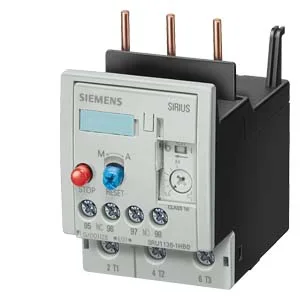
This is the S2 frame size, the mid-range physical format in the SIRIUS family. It mounts directly onto a contactor (fastening method: contactor mounting, per the spec) and uses screw-type terminals for both the main and auxiliary circuits. The front is IP20 — safe for finger contact inside an enclosed panel, but not for open-panel washdown areas.
Physical envelope: 55 mm wide, 105 mm tall, 118 mm deep. Those are the dimensions that matter when you're laying out a DIN-rail panel or a backplate. That means you can butt it against adjacent devices on three sides, which helps with panel density. Mounting position is flexible: vertical mounting surface with ±135° rotation and ±45° tilt front-to-back. That covers most panel orientations you'll encounter. The shock resistance is rated at 8g for 10 ms, which is adequate for industrial machinery but not for mobile equipment or high-vibration applications.
Ratings that matter for the BOM
This relay carries ATEX approval (DMT 98 ATEX G 001), so it's listed for use in potentially explosive atmospheres — a common requirement in chemical, grain, and pharmaceutical lines. Auxiliary contact ratings cover the standard control voltages you'll see in a panel: 1 A at 24 V, 3 A at 120 V, 2 A at 230 V, 1 A at 400 V. The 24 V rating at 1 A is the one most often used for PLC inputs — it's enough to drive a typical 24 VDC input module without a separate interposing relay. Wire range is generous: solid conductors from 0.5 to 2.5 mm² (doubled up), and stranded up to 35 mm². For the main circuit, AWG 18 to 1. That covers everything from control wiring to power feeds without needing adapters.