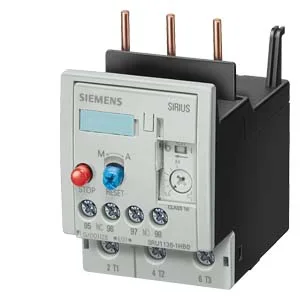
The 3-pole main circuit uses screw-type terminals; the auxiliary and control circuit uses Cage Clamp terminals for tool-less wiring.
Trip Class 10 governs the thermal curve — this relay opens within 10 seconds on a locked-rotor condition, fast enough to protect most IEC frame motors without nuisance tripping on normal starting inrush. Shock resistance of 8g for 10 ms covers normal contactor switching vibration but not repeated hammering. The mounting position allows ±135° rotation and ±45° tilt from vertical, so it adapts to tight enclosures as long as the surface is vertical. Auxiliary contact ratings cover the common control voltages: 1 A at 24 V, 3 A at 120 V, 2 A at 230 V, and 1 A at 400 V — enough to drive a PLC input or a small contactor coil. The 6 kV surge voltage resistance (rated value) ensures the auxiliary circuit holds up against switching transients from the main contactor. Power dissipation is 3.5 W per pole, so in a multi-relay cabinet, account for roughly 10.5 W total heat to avoid derating adjacent components. Wire ranges: solid conductors accept 2x (0.5 … 2.5 mm²); stranded accepts 2x (0.75 … 25 mm²) or single 0.75 … 35 mm². This covers most motor-circuit power wiring up to about 35 mm². The auxiliary circuit uses Cage Clamp terminals accepting 2x (0.5 … 1.5 mm²) finely stranded with ferrules, or 2x (20 … 14) AWG. Relative humidity up to 100% is allowed during operation — no derating for condensation as long as the IP20 front is respected.
The relay carries ATEX protection type DMT 98 ATEX G 001, certifying it for use in potentially explosive atmospheres (Group II, Category 2G). The substance prohibition date of 07/01/2006 aligns with RoHS compliance. These markings on the nameplate match what a quality doc control check expects for panel certification packs.