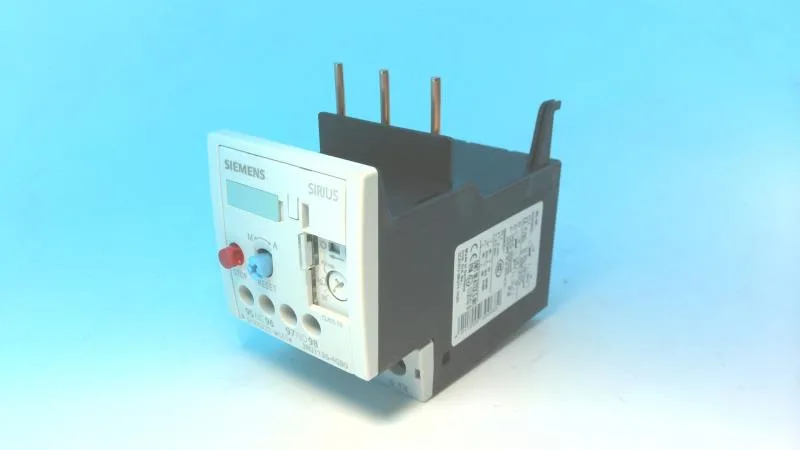
It trips on a CLASS 10 curve, meaning it disconnects within 10 seconds at 7.2× the set current, which is the standard for standard induction motors that don't need the faster CLASS 5 or the slower CLASS 20. The S2 frame size tells you it pairs with the S2 contactor frame in the SIRIUS modular system. It mounts directly onto the contactor — the fastening method is contactor mounting, so no separate DIN-rail clip is needed, and it shares the contactor's footprint.
The CLASS 10 trip class governs the motor protection curve. For a motor starting a fan or pump with a moderate inertia load, CLASS 10 gives enough time to start without nuisance tripping, but clears quickly enough to protect the winding from a locked-rotor condition. If your application has a high-inertia load that needs a longer start time, you'd need a CLASS 20 relay instead. The S2 frame size (55 mm wide, 105 mm high, 118 mm deep) fits the SIRIUS modular system. The depth of 118 mm is the dimension that matters most when planning the gland plate clearance or the enclosure depth — it's the distance from the mounting surface to the furthest point of the relay body. Termination is screw-type for both the main and auxiliary circuits. The main circuit accepts solid conductors from 2x (0.5... 1.5 mm²) up to 0.75... 35 mm² stranded, with AWG equivalents from 2x (18... 3) to 1x (18... 1). The auxiliary circuit handles 2x (20... 16) AWG solid or 2x (18... 14) AWG stranded. This covers the range from control wiring up to the motor power feed. The 100% relative humidity rating during operation means it can handle condensing environments inside the enclosure, provided the IP20 front is respected.
The 3RU1136-4GB0 carries ATEX approval for explosive atmospheres (type DMT 98 ATEX G 001), which means it's certified for use in Zone 2 gas environments when paired with an appropriate contactor and enclosure.