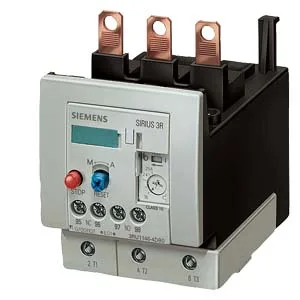
The Siemens 3RU1146-4JB0-ZW95 is a SIRIUS S3 thermal overload relay — the component that sits between a contactor and the motor, monitoring current and tripping on sustained overload before the winding temperature rises past the insulation class.
Fastening method is contactor mounting — it snaps directly onto the matching SIRIUS contactor, no DIN rail required for the relay itself. Mounting position allows a vertical mounting surface with ±135° rotation and ±45° tilt forward/backward, so the panel layout can angle the relay for access without derating. That zero-clearance stack means you can gang contactor-relay pairs side by side without extra spacing, saving rail real estate.
Main circuit uses screw-type terminals accepting stranded 2x (10 … 50 mm²) or 10 … 70 mm², and solid 2x (0.5 … 1.5 mm²) or 2x (0.75 … 2.5 mm²). AWG equivalents for main contacts: 2x (10 … 1/0) or 1x (10 … 2/0). Auxiliary and control circuit also screw-type, accepting AWG 2x (20 … 16) or 2x (18 … 14). That range covers panel wire from control-circuit 1.5 mm² up to motor-circuit 70 mm² — no need for terminal reducers on the larger feeds.
Environmental and protection
Protection class on the front is IP20 — finger-safe but not sealed; install inside a cabinet rated for the environment. Operating temperature range -20 … +70 °C, storage and transport -55 … +80 °C. Relative humidity during operation up to 100 %, so condensation-prone enclosures are acceptable as long as the IP20 front is not directly exposed. Shock resistance 8g / 10 ms, surge voltage resistance rated 8 kV. ATEX certification DMT 98 ATEX G 001 covers use in potentially explosive gas atmospheres when paired with the appropriate contactor and upstream protection.
For type of coordination 2 (no damage to the relay under short-circuit conditions), the required upstream fuse is gG: 125 A. For type of coordination 1 (relay may be damaged but no hazard), gG: 200 A. Auxiliary contact ratings: 1 A at 24 V, 3 A at 120 V, 2 A at 230 V, 1 A at 400 V — these are the switching capacities for the signal circuit back to the PLC or control relay.