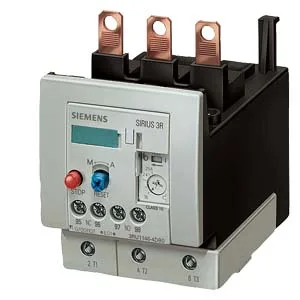
It protects motors against overload and phase failure by monitoring current through the main circuit and tripping the contactor via its auxiliary contacts.
This zero-clearance design lets you pack relays tightly in a row without derating, which matters when you're fitting multiple motor starters into a single enclosure. The auxiliary contact ratings cover the control voltage range you'll find in most panels: 3 A at 120 V, 2 A at 230 V, 1 A at 400 V. At 24 V the contact is rated 1 A. These are the switching capacities for the N/C and N/O contacts that signal the contactor coil and the PLC input — verify your control transformer and input card can supply the minimum load to keep the contacts clean. Power dissipation per pole is 6.3 W. For a three-pole relay that's 18.9 W total heat to manage inside the enclosure. If you're grouping multiple starters in a sealed cabinet, factor this into your thermal calculation to avoid exceeding the 70 °C operating limit. Surge voltage resistance rated at 8 kV and shock resistance 8g / 10 ms — the relay is built for industrial environments with transient-heavy supplies and vibration from contactors and motor starting.
Fastening method is contactor mounting — the relay clips directly onto the matching SIRIUS contactor, no DIN rail required. The mounting position allows a vertical mounting surface with +/-135° rotation and +/-45° tilt to the front and back, giving flexibility in panel layout. Main circuit terminals accept stranded wire 2x (10... 50 mm²) or 10... 70 mm²; auxiliary and control circuit terminals accept solid 2x (0.5... 1.5 mm²) and 2x (0.75... 2.5 mm²), or AWG 2x (20... 16) and 2x (18... 14). All terminals are screw-type.
The relay carries ATEX protection type DMT 98 ATEX G 001, certifying it for use in potentially explosive atmospheres — relevant for chemical, pharmaceutical, or grain-handling installations where motor starters must not become ignition sources. Protection class on the front is IP20. Substance prohibition date per RoHS/REACH is 07/01/2006.