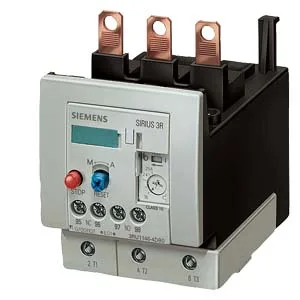
The IP20 front face keeps live terminals behind the enclosure door; the relay itself sits inside the panel, not in the washdown zone.
CLASS 10 is the most common trip class for general-purpose motor starting — it gives the motor time to accelerate under load without nuisance tripping, but still clears a locked-rotor condition fast enough to avoid winding damage. The relay is coordinated with upstream fuses: Type 2 coordination requires a gG 160 A fuse; Type 1 coordination allows a gG 250 A fuse. That distinction matters for panel builders who need to limit downstream damage after a fault — Type 2 leaves the relay usable after a short circuit, Type 1 may require replacement.
That means it can be packed close to adjacent components without derating, as long as side clearance is respected.
Main circuit terminals accept stranded conductors from 10 to 70 mm² (or 2x 10 to 50 mm²), and AWG 10 to 1/0 (2x) or 10 to 2/0 (single). Auxiliary and control circuit terminals take 0.5 to 1.5 mm² (2x) or 0.75 to 2.5 mm² (2x), with AWG equivalents 20-16 (2x) and 18-14 (2x). All terminals are screw-type — no spring-cage option on this variant.
The built-in auxiliary contacts are rated for switching at multiple control voltages: 1 A at 24 V, 3 A at 120 V, 2 A at 230 V, 1 A at 400 V, and lower ratings at 110 V (0.22 A), 125 V (0.22 A), and 220 V (0.11 A). These cover most PLC input and contactor coil circuits in common control voltages. The 3 A at 120 V rating is the highest — useful for North American control schemes.