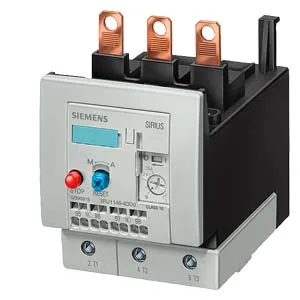
The Siemens 3RU1146-4MD0 is a SIRIUS thermal overload relay — size S3 — used to protect three-phase motors against overload and phase failure by monitoring motor current and tripping the contactor when the thermal model exceeds the Class 10 curve. It mounts directly to a contactor (contactor mounting), so the whole assembly slides onto a DIN rail or screws to a backplate as a single unit — no separate bracket or wiring between the relay and contactor coil.
The relay accepts screw-type terminals for the main circuit — solid wire 2x (0.5 … 2.5 mm²) or stranded 2x (10 … 50 mm²) and up to 10 … 70 mm² — so it handles motor leads from fractional-horsepower up to about 30 kW at 400 V without needing adapters. Auxiliary and control circuits use Cage Clamp terminals (2x 20 … 14 AWG), which is a spring-cage connection — no screw tightening needed, just push the stripped wire in. That saves time on a multi-relay panel. Shock resistance rated at 8g / 10 ms, so it holds calibration on a machine tool or a conveyor line with moderate vibration. Surge voltage resistance of 8 kV (impulse) means it can handle switching transients from contactor coils and nearby VFDs without false tripping.
The relay is 70 mm wide, 120 mm tall, 140 mm deep — the S3 footprint. It mounts with a vertical mounting surface and can be rotated ±135° or tilted ±45° front-to-back, so you can fit it into tight corners without special brackets. Clearances: 0 mm upwards, forwards, backwards, and downwards — so it can butt against other components or the cabinet wall with no air gap needed for cooling (the relay is self-heating, but the contactor handles the main heat). Side clearance is 6 mm. Power dissipation per pole is 7 W — total 21 W at full load. That's modest, but if you pack several relays in a small enclosure, you'll want to account for it in the thermal design.
This lets you size the upstream protection to match your selectivity scheme. The relay carries ATEX approval (DMT 98 ATEX G 001), so it's suitable for use in potentially explosive atmospheres — gas groups — when paired with an appropriate contactor and enclosure. Relative humidity during operation: 100 % — no derating needed for condensing environments, as long as the enclosure is rated for it.