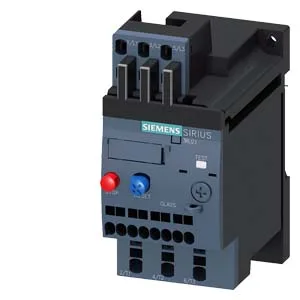
What the CLASS 10 trip rating means for motor protection
The 3RU2116-0AC1: This is the standard for standard-duty motor starting — it allows the motor to accelerate under load without nuisance tripping, but still protects against a locked-rotor condition fast enough to meet IEC 60947-4-1 requirements. The overload release is thermal, using a bimetallic strip heated by the motor current. Ambient temperature compensation is active from -40 to +60 °C, so the trip curve stays accurate across the panel's internal temperature range.
Panel fit and wiring — size S00 with spring-loaded terminals
It mounts in any position and is designed for stand-alone installation, not ganged to a contactor. The auxiliary switch is integrated — no separate add-on block needed for the N/C alarm contact. Power dissipation per pole is 1.6 W — at full load the relay dissipates about 4.8 W total across three poles. Budget this into the panel thermal calculation, especially in a sealed enclosure.
Auxiliary contact ratings — what voltage matches your control circuit
These are the make/break capacities for the alarm circuit — match the contact rating to your PLC input or control relay coil draw. The note for message "Tripped" indicates this auxiliary contact changes state when the overload relay trips — it's the N/C (normally closed) contact that opens on overload, commonly wired into a safety chain or PLC digital input.
Lifecycle and sourcing — active production, quoted to order
The relay carries a substance prohibitance date of 10/01/2009, confirming RoHS compliance per EU Directive 2002/95/EC.