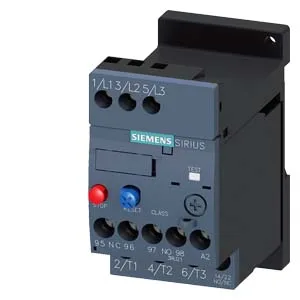
The Siemens 3RU2116-0BB1 is a SIRIUS thermal overload relay in Size S00, Trip Class 10, rated 690 V. It protects a motor branch against sustained overcurrent by tracking the thermal load — when the internal bimetal strip trips, it opens the integrated auxiliary switch and sends a signal back to the contactor coil, dropping the motor off line. The "for message Tripped" note on the product means the auxiliary contact position changes on a trip event, so the PLC or annunciator sees a clean status change. It mounts stand-alone or directly onto a SIRIUS contactor of matching frame size, in any orientation, and the screw terminals accept 2x (0.5 to 1.5 mm²) or 2x (0.75 to 2.5 mm²) solid or stranded wire.
Trip Class 10 — what it means for the motor start
That is the standard for standard-duty induction motors — pumps, fans, compressors with normal acceleration times. If the motor has a heavy inertia load (centrifuge, crusher, long conveyor) that needs longer to start, you would step up to Class 20 or Class 30. For the 3RU2116-0BB1, the Class 10 curve is fixed; there is no field-selectable class. The temperature compensation range of -40 to +60 °C keeps the trip curve stable across the panel ambient, so the relay does not nuisance-trip on a hot day or fail to protect on a cold one.
Physical fit — dimensions and mounting
The relay measures 45 mm wide, 89 mm tall, and 80 mm deep. It mounts stand-alone — no contactor required underneath — but the typical installation is snapped onto a SIRIUS 3RT2 contactor of the same S00 frame size. The screw terminals for the main circuit use M3 screws; the screwdriver tip needed is Pozidriv PZ2 with a shaft diameter of 5 to 6 mm. The auxiliary switch is integrated into the relay body, so no separate side-mount block is needed for the trip/alarm signal.
Switching ratings — what the auxiliary contacts can handle
The integrated auxiliary switch is rated for a range of control voltages. At 24 V it carries 2 A; at 120 V it carries 3 A; at 230 V it carries 2 A; at 400 V it carries 1 A; at 690 V it carries 0.75 A. For DC control circuits, at 60 V it is rated 0.3 A, at 110 V and 125 V it is rated 0.22 A, and at 220 V it is rated 0.11 A. These are the maximum continuous currents the auxiliary contacts can make and break — useful for sizing the PLC input or relay coil load on the trip signal. The per-pole power dissipation is 1.6 W.
The substance prohibitance date of 10/01/2009 indicates RoHS compliance (the part contains no restricted substances above the threshold as of that date). MTTF with high demand rate is 2,280 years — a reliability figure used for SIL calculations in safety circuits, though the relay itself is not a safety-rated device. No UL, CSA, or IEC certification numbers are listed in this record, but the SIRIUS family typically carries IEC/EN 60947-4-1 compliance; verify the specific markings on the nameplate for your jurisdiction.