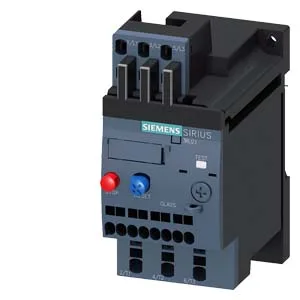
Its Trip Class 10 means it will trip within 10 seconds at 7.2× the set current — standard for general-purpose motor starting where the acceleration time is under 10 seconds.
The auxiliary contact is rated at 2 A at 24 V, 3 A at 120 V, and 2 A at 230 V — these are the switching capacities for the N/C and N/O signaling contacts that feed the PLC input or the contactor coil circuit. At 400 V the relay is rated for 0.06 kW motor load; at 690 V it is rated for 0.09 kW — these are the maximum three-phase motor ratings at the respective line voltages, so size the overload relay to the motor FLA, not the other way. The relay compensates for ambient temperature changes between -40 and +60 °C, so it tracks the motor's thermal state rather than the panel's internal temperature.
Main current circuit uses spring-loaded terminals accepting 2 × (0.5 to 2.5 mm²) solid or stranded wire — no screw torque to verify, just strip and push. Dimensions are 45 mm wide, 79 mm deep, 102 mm high — fits the S00 contactor footprint.
The auxiliary switch is integrated into the relay body, not a separate add-on module. Substance prohibitance date is 10/01/2009 — the relay complies with RoHS and REACH substance restrictions as of that date. MTTF with high demand rate is 2,280 years — a reliability figure for safety-related applications where the relay is exercised frequently.
What the 'Tripped' note means
The relay carries a note 'for message Tripped' — this refers to the auxiliary contact configuration that signals a trip condition to the control system, typically a N/C contact that opens when the relay trips.