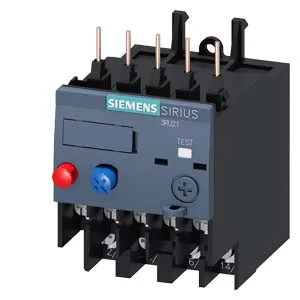
SIRIUS 3RU2116-0FJ0 — thermal overload relay for motor protection
The Siemens 3RU2116-0FJ0 is a SIRIUS thermal overload relay in the compact size S00 frame, designed to protect motors against overload and phase failure by monitoring the motor current and tripping the associated contactor when the thermal model exceeds the set threshold.
Trip class and what it means for the motor circuit
Class 10 is the standard trip class for IEC motor starters driving pumps, fans, and compressors where the motor reaches full speed within 10 seconds. The thermal bimetallic release tracks the motor's thermal replica — it allows the starting current to pass without nuisance tripping but protects against sustained overloads that would damage the winding insulation.
Physical fit and contactor integration
It mounts directly onto the contactor via the fastening method specified for contactor mounting, so no additional DIN-rail space is consumed; the relay sits on top of the contactor and the main power connections pass through the relay's ring cable lug terminals (M3 screw size). The screwdriver shaft diameter is 5-6 mm with a Pozidriv PZ2 tip for the terminal screws.
Auxiliary contact ratings and the tripped signal
The integrated auxiliary switch provides a 'Tripped' signal contact — this is the N/C or N/O contact that changes state when the relay trips, used to signal the PLC or annunciator that the motor has been disconnected. For DC control circuits at 24 V, the 2 A rating is sufficient for most PLC input modules or relay coils; at 125 V DC the rating drops to 0.22 A, so confirm the load current in the signal loop at the operating voltage.
Environmental limits and temperature compensation
Temperature compensation is active from -40 °C to +60 °C, meaning the trip curve stays accurate across that range — important for outdoor enclosures or unheated plant areas where the ambient temperature swings. Power dissipation per pole is 1.6 W at rated current — three poles total 4.8 W heat inside the enclosure. This is low enough that no forced cooling is needed in a standard IP54 panel, but it should be factored into the enclosure thermal budget when the starter is densely packed.
The MTTF figure of 2,280 years with high demand rate reflects the mechanical reliability of the bimetallic mechanism in a safety-related application — this is a statistical figure for the failure rate in the safe state, not a service life guarantee.