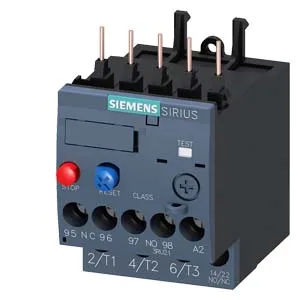
It's the part that sits between the contactor and the motor, watching current and protecting against sustained overloads — the 'Tripped' message on the front tells you exactly what happened. Rated for main circuit voltages up to 690 V, it's specified for motor protection at 0.18 kW on a 400 V supply, 0.18 kW at 500 V, and 0.25 kW at 690 V. That 0.18 kW at 400 V is the number you'd use for a standard IEC motor selection — it matches the motor FLC curve, not a theoretical maximum. The auxiliary contact ratings cover the common control voltages you'll see in a panel: 2 A at 24 V, 2 A at 230 V, 1 A at 400 V, and 0.75 A at 690 V. At 120 V it's rated 3 A — that's a solid signal for a PLC input or a status lamp. These are the numbers that matter when you're coordinating the control circuit, not just the power side.
Mounts directly to the contactor — no separate base or DIN-rail adapter needed. Fastening method is contactor mounting, with M3 screws for the main contacts. Screw-type terminals on the main circuit accept 2x (0.5 to 1.5 mm²) or 2x (0.75 to 2.5 mm²) solid or stranded wire. The screwdriver spec is Pozidriv PZ2 with a shaft diameter of 5 to 6 mm — don't use a flathead on these, you'll strip the head. Dimensions are 45 mm wide, 76 mm high, 70 mm deep. That's a compact footprint for a Size S00 relay — it fits in a standard 45 mm-wide contactor slot without stealing extra DIN rail space. Mounting position is any orientation, so you're not fighting panel layout constraints.
Environmental and reliability
The compensation range is what governs accuracy in a hot panel — above 60 °C the trip curve may drift, so keep that in mind if the relay is near a drive or transformer. MTTF with high demand rate is listed at 2,280 years — a calculated figure for a non-repairable device under continuous operation.
Substance prohibitance date is listed as 10/01/2009 — the RoHS compliance date for the European directive.