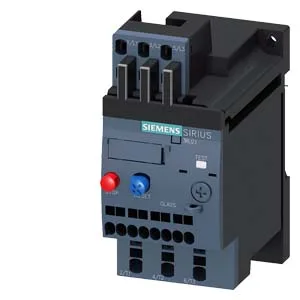
The auxiliary contact ratings span the control-voltage range you are likely to encounter: 2 A at 24 V, 2 A at 230 V, 1 A at 400 V, and 3 A at 120 V — so it switches PLC inputs or contactor coils across common control voltages without an interposing relay. Motor power assignments: 0.18 kW at 400 V, 0.18 kW at 500 V, 0.25 kW at 690 V. These are the maximum three-phase motor ratings the relay can protect at those line voltages — match these to your motor nameplate, not the contactor rating. The relay is temperature-compensated from -40 °C to +60 °C, so the trip curve stays accurate across the panel ambient range without manual adjustment.
Mounts in any position — stand-alone installation, no DIN-rail adapter required. The spring-loaded terminals on the main circuit accept 2× (0.5 to 2.5 mm²) solid or stranded conductors, so you can loop-through the motor leads without separate terminal blocks. The integrated auxiliary switch (one N/O + one N/C) is wired via the same spring-cage terminals; use a 3 mm diameter screwdriver with a 3.0 × 0.5 mm tip for actuation. Depth is 79 mm, width 45 mm, height 102 mm — the S00 footprint fits alongside S00 contactors in a compact motor-starter row. The 'Tripped' message indicator gives a local visual flag when the relay has operated, which speeds fault-finding on the line.