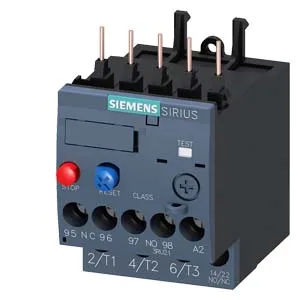
What 3RU2116-0JB0 actually does in the panel
CLASS 10 trip behaviour means it reacts within roughly ten seconds at six-times setting — the standard fast-trip curve for normal motor starts where the inrush clears in under a second and any longer dwell is a real fault.
Auxiliary contact ratings the panel builder will check
The DC derating curve is steep — anything above 125 VDC on the trip contact halves the switching current, which matters when the relay feeds a 220 VDC coil rather than a 24 VDC input. Power dissipation is 1.6 W per pole, so the thermal load in a densely packed cabinet is modest. The relay is temperature-compensated from -40 to +60 °C, meaning the trip current holds steady across that band and does not drift with ambient cabinet warmth; operating envelope extends to -40 to +70 °C, and storage/transport to -55 to +80 °C.
Mounting, wiring, and what fits next to it
The relay fastens directly to the matching SIRIUS S00 contactor, so the wiring enters the same terminal row — no DIN-rail bracket or separate wiring duct. A tripped indication is provided via the integrated auxiliary, with the relay's note field reading "Tripped" for the status message — useful for routing the NC contact back to a PLC input so the operator can distinguish a thermal trip from a contactor-side power loss without opening the cabinet.