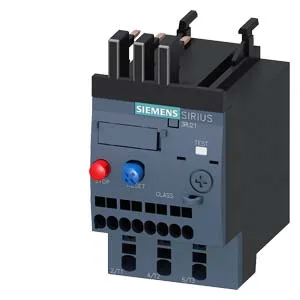
The "-ZW97" suffix means this variant carries a special "Tripped" message output — a factory-coded note that flags the relay has operated, useful for remote indication or PLC input without an additional auxiliary block. That's the standard for standard-duty motor starts — pumps, fans, compressors that don't need a long acceleration curve. For high-inertia loads that need longer start times, you'd step up to a Class 20 or 30 relay. Auxiliary contact ratings cover both AC and DC control circuits: 2 A at 24 V, 3 A at 120 V, 2 A at 230 V, and 1 A at 400 V. That range means it can switch PLC inputs, contactor coils, or indicator lamps across common control voltages without an interposing relay.
Mounts directly onto a contactor — the fastening method is "contactor mounting", which means it clips onto the front of a matching SIRUS contactor (typically a 3RT2 series in S00). No DIN-rail space consumed; the relay piggybacks on the contactor footprint. Main current circuit connections use spring-loaded terminals — no screwdriver needed for the power wires, which speeds up panel wiring. The spring terminals accept 2x (0.5... 2.5 mm²) solid or stranded copper. Auxiliary terminals use screw-type connections, requiring a 3 mm diameter screwdriver tip (3.0 x 0.5 mm blade). Physical footprint: 45 mm wide, 87 mm tall, 70 mm deep. That's the S00 standard — it fits alongside other SIRIUS S00 components on the mounting rail without overhang.
Substance prohibitance date is 10/01/2009, indicating RoHS compliance from that date forward. MTTF with high demand rate is 2,280 years — a reliability figure for safety-related applications.
Ratings and selection
Motor power ratings at 400 V are 0.25 kW, at 500 V 0.37 kW, and at 690 V 0.55 kW. Current ratings at 480 V and 600 V are 1 A each. Operating frequency is 50... 60 Hz, which covers standard mains frequencies worldwide. Power dissipation per pole is 1.6 W — three poles means about 4.8 W total heat to manage inside the enclosure. That's low enough that no special ventilation is needed in a standard IP54 panel, but worth checking if the cabinet is densely packed.