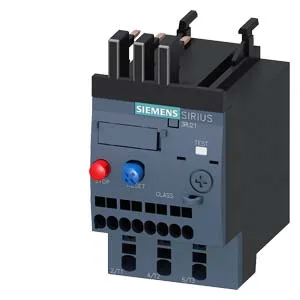
It mounts directly onto a contactor (contactor mounting) and connects to the main circuit via spring-loaded terminals (screwless push-in), accepting 2x (0.5... 2.5 mm²) solid or stranded wire. An integrated auxiliary switch provides a "Tripped" signal output. The relay is temperature-compensated from -40 to +60 °C and operates in ambient temperatures from -40 to +70 °C, making it suitable for unconditioned electrical rooms or outdoor cabinets within that range.
The headline motor rating is 0.37 kW at 400 V (AC-3e duty), which sets the maximum continuous motor load this relay can protect. At 500 V it is rated for 0.55 kW, and at 690 V for 0.75 kW — the higher voltage allows a slightly larger motor at the same current limit. Auxiliary contact ratings cover both signal-level and pilot-duty switching: 2 A at 24 V, 3 A at 120 V, 2 A at 230 V, and 1 A at 400 V. These are the current-carrying limits for the integrated trip-indication contact — useful for feeding a PLC input or a remote alarm lamp. The auxiliary switch is rated for switching at 690 V as well, though at a reduced 0.75 A.
Depth is 70 mm, height 87 mm — compact enough for dense contactor-assembly layouts. Fastening is via contactor mounting, meaning it clips directly onto the matching SIRIUS contactor (e.g., 3RT2 series Size S00) without extra hardware. Terminals accept a 3 mm diameter screwdriver shaft (3.0 x 0.5 mm tip) for the spring-release mechanism. Wire preparation: strip length per the spring-cage spec, no ferrule required for solid wire.
Substance compliance includes a RoHS prohibitance date of 10/01/2009, confirming the part meets EU RoHS restrictions for substances like lead, mercury, and cadmium. No separate UL or CSA listing is recorded in this data set, but the SIRIUS series typically carries IEC/EN 60947-4-1 certification — verify for your jurisdiction if a specific agency mark is required.